
Native Neighbors: Witch Hazel, Moose Maple, Holly
The Witch Hazel
As the forests and meadows are dusted with snow and the bare trees wave in the winds, what is that shock of yellow or orange color in the periphery? It almost looks like a budding plant at the wrong time of year. Move closer, and you may spy the late-flowering native Hamamelis – commonly known as Witch-Hazel.
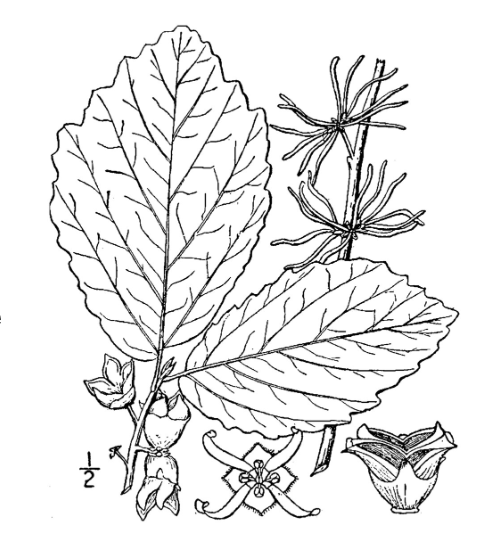
But what pollinates these spider-like flowers so late in the year? Observations reveal certain kinds of cold-adapted moths, gnats, or even some bees help pollinate the Witch-Hazel. Because they flower when most other plants have become dormant, there is both risk and reward – they are one of the only flowering plants available, but the availability of pollinators has also dwindled.
The “witch” part of Witch-Hazel is actually not related to the word for magical practitioner. It seems to derive from the Old English wícan, which means “to yield; give way” according to Bosworth Toller’s Anglo-Saxon dictionary. As for the “hazel’ part of the equation, the leaves somewhat resemble those of a hazel tree – which is another native Vermont plant, but is not in the same plant family and is classified as Corylus americana.
The Witch-Hazel has been used in folk medicine by the native peoples of this land, as well as by settlers and modern-day herbalists. One common use is through extract for skin care for any number of ailments – though not all these herbal remedies have been vigorously studied.
If you’re looking to replace invasive or non-native shrubs in your backyard or community spaces, Witch-Hazel could be a great, hearty alternative! Replace those buckthorns, autumn olives, or multi-flora rose with this native plant to help crowd out other invasives. Every plant truly makes a difference.
The Holly Family
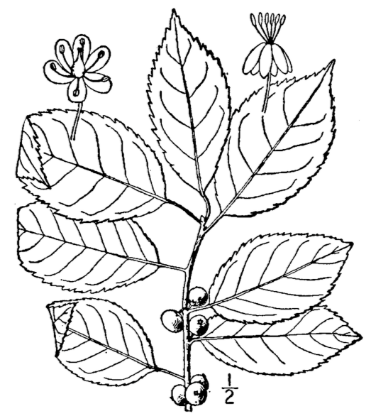
Winter is a time of great contrast, often with fields of snow and bare, swaying branches that rattle like antlers of battling stags. Sometimes in this world of white, we are gifted with a spectacular sight – a feast of red berries for birds on low bushes at the forest edge. Thus, the name “winterberry,” a native plant neighbor who provides nourishment during the cold season, and sometimes adorns a farmhouse door during the winter holidays.
The Holly family, known formally as Ilex, has hundreds of species, several of which are native to our corner of the Green Mountains. While the word “holly” might conjure images of glossy, sharp evergreen leaves with red berries, the plant that best fits this description, the American Holly (Ilex opaca) prefers warmer climates, and is not usually found in Windham County.
Winterberry is a member of the holly family, and is also called fever bush, coralberry, Canada holly, or more technically, Ilex verticillata. Not all hollies are evergreen – and indeed, the winterberry is deciduous, meaning it drops its leaves in the winter. Its red berries persist, however, sometimes long into the snowy season. According to the USDA, over 48 species of birds eat winterberries – an important food source in the winter!
Though we call the red fruit a “berry,” it is actually a drupe: a pit surrounded by flesh, like a peach, cherry, or olive. This holly family is also quite old – having been widespread even as far back as the Cretaceous Period (143 to 66 million years ago), and previously covered large swaths of the earth as one of the plant families that thrived in laurel forests.
In our corner of Vermont today, there are a few native Ilex species, including winterberry, mountain holly (Ilex mucronata), and the smooth winterberry (Ilex laevigata). If you’re looking for native plants that will both look beautiful and benefit wildlife, look no further than the above! These hollies can replace the invasive japanese barberries and glossy buckthorns. It’s also important to consider our changing climate, and there may be other native holly species that aren’t currently present in Windham County today, but may be in the future.
Moose Maple
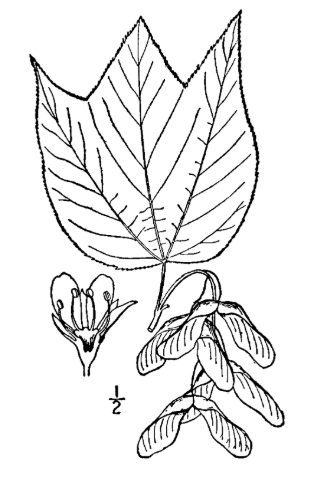
The big trees get all the attention: towering white pines, gently wavering poplars, and beloved, sturdy sugar maples are favorites in Vermont. But under the canopy, there live many other trees and shrubs – all playing important roles in our ecosystems. If you wander the woods regularly, you’ve likely come across a short tree with massive green leaves and stripy bark. Rarely do they get large enough that you can’t close two hands around the trunk. This is our friend the Moose Maple, or Acer pensylvanicum.
This maple has a lot of names: Striped maple, goosefoot maple, whistlewood, and moosewood are all commonly used. The Penobscot of Maine call it atohkímosi, and the Mi'kmaq call it wapoq. It’s in the same genus (Acer) as our sugar maple (Acer saccharum) and red maples (Acer rubrum), but it’s in a distinct section of this genus called the “Snakebark maples.” This section, Acer sect. Macrantha, is almost exclusively native to Asia, with one exception – the Moose Maple here in the Northeast.
The Moose Maple is an understory specialist, meaning it thrives in shady forests and in a variety of soils, including nutrient-poor areas. It grows slowly, but steadily, reaching roughly 20-30 feet tall. Because of its beautiful striped bark, some folks use it as a shade ornamental in their gardens – and indeed, it’s a good choice for a native, small tree.
Given that Valentine’s Day is right around the corner, we have to ask, how does the Moose Maple reproduce? This tree is frequently dioecious – meaning each individual tree has either male or female flowers, and are pollinated by the wind. Occasionally, there are monoecious Moose Maples – meaning there are male and female flowers on the same tree. But this isn’t the whole story. Moose Maples are notable for their ability to change sex. A male tree one year can be female the next, and vice-versa. Not only that, we believe that this change can be in response to environmental factors, such as damage to the branches. In one study, up to 54% of striped maples changed sex in a four-year period – some multiple times. Wow!
Acer pensylvanicum is just another example of the stunning diversity throughout the Green Mountains. It’s a beautiful understory tree, but also an important source of food for snowshoe hares, porcupines, squirrels, and chipmunks. It’s used as browse by deer, and of course, moose. And, its leaves are instantly recognizable – some of the biggest you’ll see on your woodland walk.