
The following guide was written by Will Danforth, board member
Invasive, non-native plants are one of the biggest threats to biodiversity—and The Nature Museum is here to make it easy for you to help. We've created this resource to prepare you for action come fall, when many invasives outlast and often turn color after our native plants, making them easy to find.
We'll cover:
What invasive plants are, and why they matter
How to remove them—safely and effectively
Whether to manage or eradicate
Key species to watch for
How to support native ecosystems
Why does this matter? Healthy ecological function requires biodiversity.
Every species plays a role in maintaining ecosystem health, a role that has often taken millions of years to evolve. When the environment changes, as it is currently, it can take a long time for native species to adapt. Invasive alien plants—non-native species introduced after European colonization—can disrupt this balance. Some, like knotweed, garlic mustard, and purple loosestrife, outcompete native plants and create monocultures, which drastically reduce biodiversity.
Native plants feed native insects, which feed birds (especially baby birds), amphibians, and the entire food web.
Plants are the only way that the sun's energy gets transferred to all living species, through photosynthesis, thus they are essential for a healthy planet. Many insects have developed relationships with specific native plants, often over millions of years—monarch caterpillars on milkweeds (syriaca sp.) is just one well-known example.
To protect ecological function, we must promote native plant diversity and address invasives that threaten it. Monocultures threaten this delicate balance—and every invasive plant you remove helps restore it. If you want birds, you must have insects … and native plants!
How to Remove Invasive Plants From your Home Landscape
Non-chemical approaches: With over 100,000 man-made chemicals in the environment, most with untested and unintended consequences, mean it's best to avoid chemicals whenever possible.
Hand-pulling. Always the first choice, though not always feasible. Use on smaller infestations of perennials and young shrubs: garlic mustard & wild chervil; honeysuckle, barberry, burning bush, buckthorn, & multiflora rose. You can try a weed wrench on larger shrubs. Since this approach might not get the roots, it may require repetition.
Smothering with black plastic or cardboard. This will require a full season at least, and be sure to dispose of the plastic.
Repeated mowing or brush-hogging. This takes multiple years; time it so as not to disrupt nesting birds, and 2-cycle engines, if used, are bad polluters.
Goats – they'll eat just about anything! But you'll need to manage them carefully.
For biennials: these are plants that only live for two years – cut them off in their second year before they seed, and they're done. Garlic mustard, wild chervil and poison parsnip (this last one has poisonous sap which delivers a mean burn in sunlight! Wear long sleeves and cut on a cloudy day, then collect and burn it. And return, since it often blooms again.)
Chemical approaches: Sometimes you're faced with two lousy choices: use an herbicide, or resign yourself to a monoculture that will inhibit a functioning environment. Since we depend on nature for our lives, I always choose a functioning environment. And one can minimize the use of chemicals.
The herbicide I prefer is generic glyphosate, but recent changes in regulations have complicated this discussion immensely. Glyphosate binds to soil readily and has a shorter half-life than the other common choice, Triclopyr, so it's less residual in the environment. Both, importantly, kill the roots.
Cut & dab. Woody shrubs that are too large to pull by hand can be cut with a lopper or handsaw and "dabbed" with a sponge or an envelope licker with a sponge on the end. Use a 30% solution and wear gloves!!! One cup will treat hundreds of plants, and there's no collateral damage. Most effective in the fall, when shrubs are pulling their energy into their roots for the winter.
Foliar spray. It's important to understand a plant's life cycle so you can spray it at the key time. Spray in low wind, don't use more than recommended, use cardboard to protect the "good" plants. However, collateral damage is inevitable. You must treat Japanese knotweed, Asian bittersweet and purple loosestrife foliarly since the smallest nodes or root pieces can resprout.
Common Invasive Shrubs With Eradication Methods
All images are from the Vermont Invasives website, which is an excellent resource. Click here to see the complete “Gallery of Terrestrial Plants” specific to Vermont.
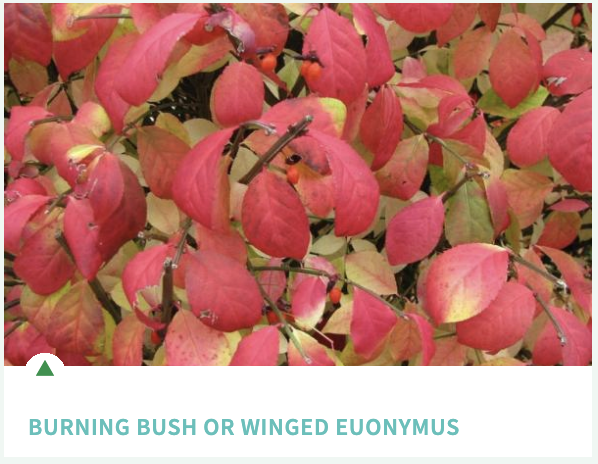
First up: burning bush (euonymus alata), a landscaping favorite for its brilliant red fall foliage, but it can escape and create a monoculture. Cambridgeport is a case study: it's everywhere (look north). Pull it if you can, use a weed wrench if you're strong and have time, otherwise cut & dab. Red chokeberry (aronia arbutifolia) or fothergilla are fine replacements.
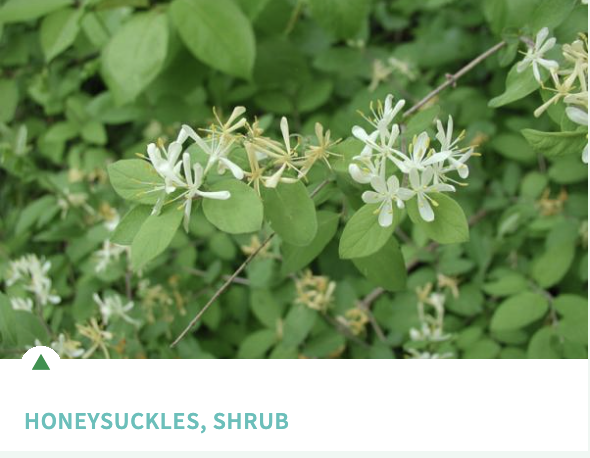
Honeysuckle (lonicera sp.) - yellow fall foliage. There are several natives and several aliens, and you're most likely to find the latter. They are surprisingly easy to pull out. Try from all four directions; one will get it started, then continue from other directions. Hang or sit upside down so the roots don't touch the soil. Cut & dab large ones.
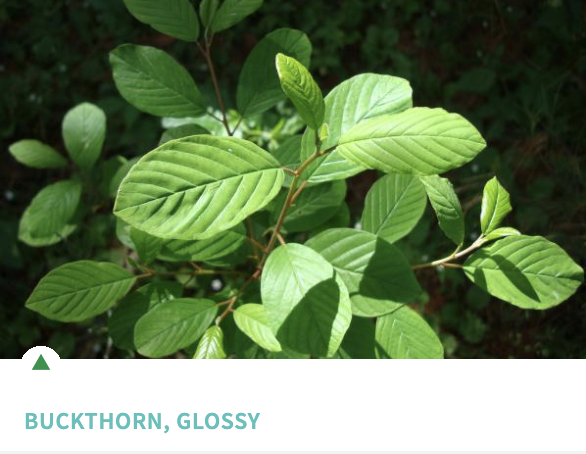
Buckthorn – two invasive species: rhamnus cathartica and frangula alnus, but mostly you'll find the latter, the glossy buckthorn. It's greenish-yellow in fall and it's also surprisingly easy to pull out. It's easy to confuse with chokecherry (prunus virginiana), a great native shrub with tiny serrations on the leaf edge, whereas buckthorn is smooth.
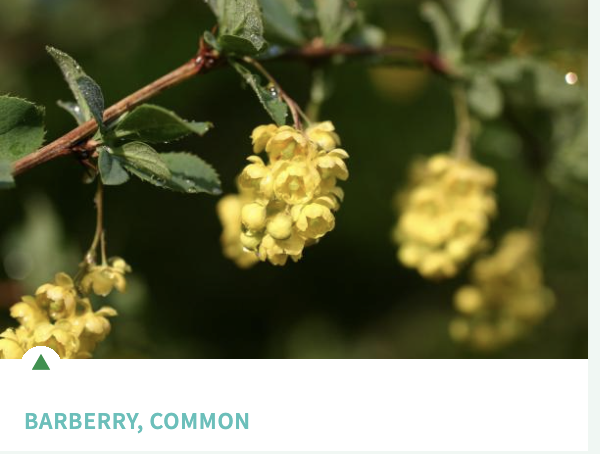
Japanese Barberry (berberis thunbegii), another landscape favorite, is orange, red or purple in fall. Yes it's got barbs, so wear gloves. Pull the smaller ones; for large ones, a hedgetrimmer will allow you to cut branches first to get close enough to cut & dab. Barberry can alter the pH and chemistry of the soil, plus mice and ticks seem to like it, so eradicating it helps in more ways than one.
Multiflora rose (rose multiflora) also has thorns, more dangerous than the barberry's, since they can infect your skin with a fungus, sporotrichosis, also called "rose picker's disease." Always wear long sleeves and gloves, and use a hedge trimmer. It grows fast, with long arching canes that'll root where they touch the ground, facilitating its spread. With up to a million seeds per plant, you'll need to check the site multiple times a year.
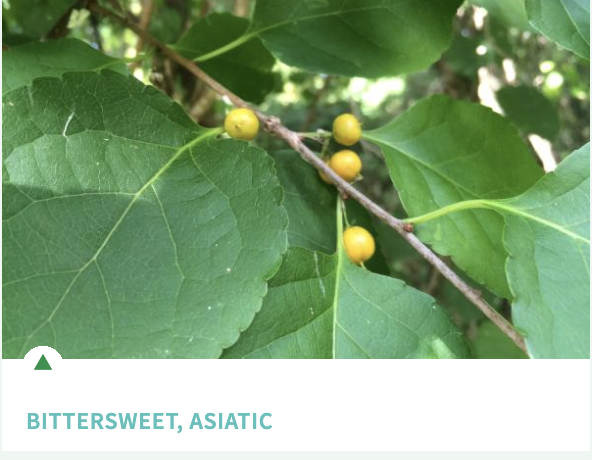
Asiatic bittersweet (celastrus orbiculatus) is a vigorous vine that climbs and strangles trees. Since tiny root fragments resprout, spray small ones before they climb. Cut & dab older woody climbers to avoid collateral damage. Use triclopyr—glyphosate is often ineffective.
Lastly, Japanese knotweed. It needs to be sprayed, ideally by a licensed applicator, because it spreads by underground rhizomes, and small pieces of stem or root can resprout. You can cut & dab, but with hollow stems, it's not as effective, and you must burn what you've cut. It's a real problem for road crews, since their excavators and mowing equipment should be cleaned before moving to another area to avoid spreading it. Small pieces will re-root or float down an adjacent stream and start a new population. It's time-consuming and expensive, but the so-called "Godzilla plant" allows nothing else to survive; in a few decades, you'll have nothing but knotweed – no insects, and no birds.
One good thing about going ballistic on invasives – it gets you outside on beautiful fall days. So head out with gloves, loppers, and a "buckthorn blaster" and enjoy yourself!